
February 2026
By Alexander Perez, Staff Reporter
The time is 10:30pm, and after an exhausting day full of classes and extracurricular activities, Collegiate student Miguel Almaraz is finally able to get into bed. Instead of pursuing sleep, however, Miguel pursues more time for himself. As the city sleeps, Miguel’s enthrallment in his phone causes dozens of trivial-seeming minutes to turn into hours, never to return. In the morning, the snooze button becomes his best friend, allotting five more crucial minutes of sleep. Why do so many students, knowing how dreadful mornings feel, repeat the cycle?
Revenge sleep procrastination, whose name originates from the Chinese phrase bàofùxìng áoyè, is a phenomenon where people deliberately sacrifice sleep in order to reclaim personal time. This has become a widespread occurrence in teenagers, with 59% of the Gen Z population reporting falling into this trap according to a study by Amerisleep. Although people criticize the phenomenon and consider it being lazy, revenge sleeptime procrastination reflects more than a lack of willpower, but a need for autonomy.
Now more than ever, teenagers are caught in an epidemic of sleep deprivation. According to research from the CDC, only 77% of high schoolers are sleeping below the baseline for sufficient sleep, which is regarded as 8-10 hours a night, and instead average only 6.5-7.5 hours.
Looking strictly at the research, not only is sleep deprivation affecting school performance, but also healthy brain development. Chronic sleep deprivation in teens is linked to higher risk of depression, anxiety, irritability, low self-esteem, and increased risk-taking or impulsive behavior, alongside associations with higher rates of car crashes due to neurological impairment.
In the real-world, however, sleep is more often than not a luxury rather than a necessity. Busy schedules and long commute times make critical time management a difficult, and sometimes impossible, task. People often have jobs to clock into and little siblings to take care of. This is on top of an already hectic workload that often leaves people without already time-consuming responsibilities stressed enough. In these scenarios, it’s impossible to pay attention to the research. An Eleventh-grader Enoc Ortiz, corroborated the harsh reality of busy scheduling, stating, “Sleep is sometimes an optional luxury. Usually, outside of school, I have to go to work. I get home around 12:00am, where I still have to shower, eat, and get ready for bed. Getting more than eight hours of sleep is always a luxury.”
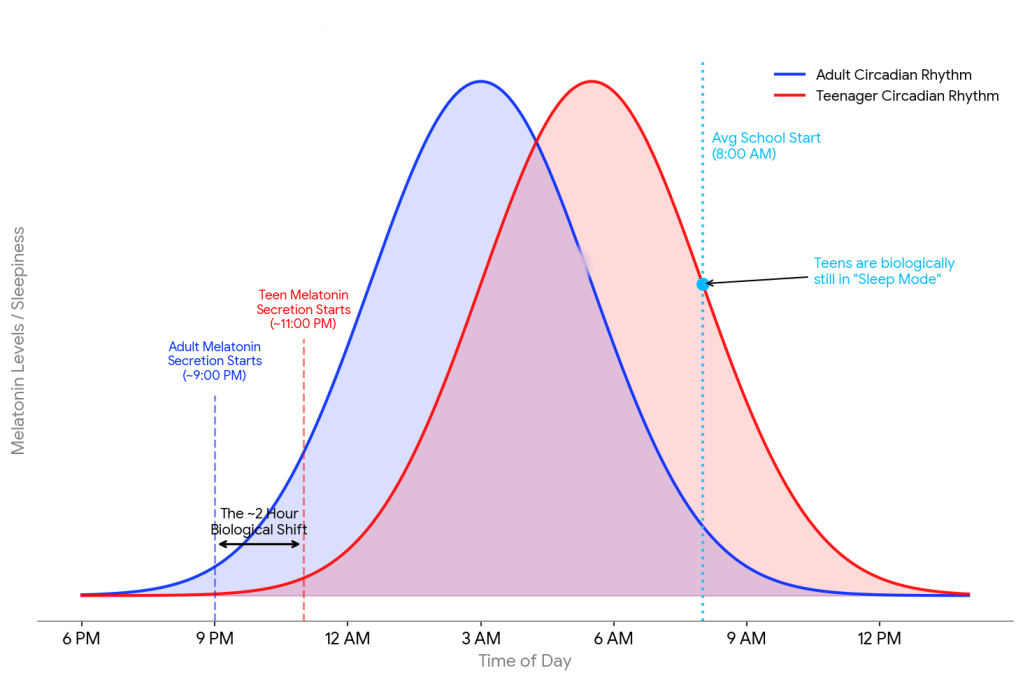
Comparison chart of adult vs. teen circadian rhythms illustrating how a 2-hour delay in the teenage biological clock leads to late-night alertness and morning exhaustion.
On top of this, human biology also plays its hand when teenagers’ sleep drives signal it’s time for bed. During puberty, adolescents exhibit a delay of melatonin release which deviates one-to-three hours to that of an adult or pre-pubescent child. This phenomenon, scientifically referred to as phase delay, results in a natural preference for later bedtimes and wake times. Students such as Enoc experience this first-hand. “When I’m not confined to a sleep schedule, I typically find myself sleeping at ~1 A.M. and waking up around noon.” This sentiment was echoed by eleventh-grader Carlos Mendieta, who stated, “[When not confined to a sleep schedule], I usually go to sleep at 1 A.M. and wake up around 11 A.M.”
“Sometimes, it does feel like I’m enjoying myself just because I’ve had a long day. It’s the only time I get to really relax, in a sense,” stated Enoc. “Unfortunately, it’s not full relaxation. Usually, it feels like I’m fighting through just to find that time I didn’t get throughout the day.” Other times, revenge sleep procrastination is just a synonym for late-night work, often as a result of a busy schedule interfering with time for critical thinking needed for complex assignments. “I often have a lot of church activities to do and I don’t find the time to finish my assignments,” stated Emmanuel Arredondo. “Oftentimes, nighttime is the only time where I can do that.”
Breaking the cycle of revenge sleep procrastination doesn’t mean a strict lights-off policy at a certain time, but instead begins with the creation of a “buffer zone,” a window of time where winding down is the priority. Sleep experts recommend replacing the highly dopaminergic trap of social media scrolling with the more sustainable, calming rhythm of a soft playlist, journaling, or a warm shower. Engaging in a consistent sleep routine and schedule can signal to the brain that the day’s work is over.
For now, the negative feedback loop of poor sleep will continue leaving its effects on students. “I see the effects of sleep deprivation on me sometimes. I know those aren’t the long-term effects, but I’ve seen the short-term effects on my body, and on my performance in school, especially sometimes before a test. I know I’m not doing the greatest, and also before any activities, I know I’m not retaining information. And it’s simply because I decided to stay up an extra hour on my phone.”
 The Cardinal Post