February 2026
As told to Isaiah Washington by Genesis & Auggie Longo
Disclaimer: This story contains religious content provided by the subjects of this story. The Cardinal Post is including it for accuracy, not as an endorsement of the beliefs expressed.
Background
“Our journey begins with a young man named Kamdin who arrived in the United States from Iran seeking asylum. Through volunteering at Casa Marianella, an asylum seeker shelter in Austin, we met him in September 2024. What started as mentorship quickly became family. We officially adopted him in July 2025, but immigration benefits don’t transfer through adoption—a fact that would soon threaten to tear our family apart.
The Interview:
1. How did you feel when you initially got the information?
When we got the call in August that our adopted son Kamdin had to appear in New York immigration court, it felt like the ground disappeared beneath us. After everything we’d been through to become a family, we were facing an impossible choice: if he appeared in person, there was a 99.9% chance he’d be detained for 6-9 months in Buffalo. If he didn’t appear, there was a 50% chance of immediate deportation with no chance to fight.
2. When did you receive this information?
We received the court notice in August 2025, just weeks after officially adopting Kamdin in July. The timing felt especially cruel—we had just become a legal family.
3. What did you do after finding out?
We immediately consulted with immigration lawyers to understand our options. Then we made a decision to face it head-on. We refused to let fear paralyze us. Instead, we started preparing for court while continuing to plan for Kamdin’s future—enrolling him in college, decorating his first real bedroom in our new home—as if the promise of keeping our family together was already secure.
4. How did you feel or react to the information?
Beyond the initial shock, we felt a deep determination. Yes, our flesh wanted to operate in fear, maybe hide Kamdin or stay paralyzed. But we knew if we focused on the odds, we’d let fear steal our hope and faith.
5. What did you do to comfort each other?
We prayed together constantly. We fasted. We spoke life over our situation. I wrote in my Bible thanking God for the miracle before it happened. We talked about exciting future plans—Kamdin starting college, family trips, holiday traditions—refusing to let the threat steal our joy. We held each other close and reminded Kamdin every day that he was loved and we were fighting for him.
6. What did you do to prepare yourselves for the situation?
Practically, we gathered all documentation showing Kamdin’s life here—his adoption papers, GED certificate, college enrollment, medical records, etc. Spiritually, we prepared through prayer and fasting. Emotionally, we had honest conversations about living in the paradox of faith—taking action while trusting God, having peace in chaos, believing for a miracle while knowing we’d still praise God regardless of the outcome.
7. How did you feel when you had to face the outcomes?
The morning of court, I felt supernatural peace. Like Abraham on the mountain with Isaac—we knew God would provide, but we said yes before seeing it happen. I wrote in my Bible that morning, thanking God for the work already being finished. I celebrated the miracle before I saw it.
8. What happened when you went?
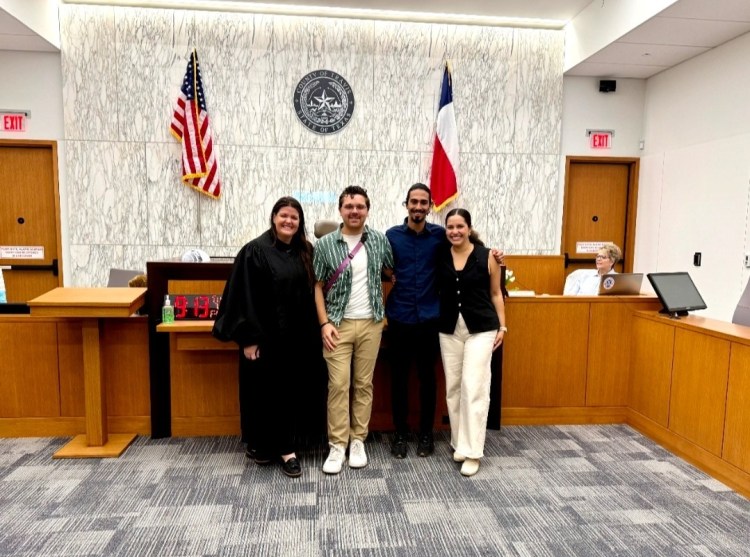
We went to the immigration court together, at our lawyer’s office in Austin. Kamdin had to stand before the judge virtually while we watched, praying silently. The courtroom was intimidating, clinical. Every word mattered. Every document was scrutinized. But we stood there as a united family.
9. What did you think the outcome might be?
The lawyer had prepared us for the worst—either months of detention or immediate deportation. The statistics were against us. But in my heart, I held onto hope that we’d walk out together. I refused to let the numbers dictate my faith.
10. How did the experience affect you?
This experience transformed us. We’re not the same people we were before. It taught us what it means to fight for family, to stand against impossible odds, to live in faith when everything says to fear. It showed us that the biggest miracle isn’t just the outcome, but how God transforms your heart through the battle.
11. What was your initial reaction to the official outcome?
When we walked out of that courtroom together—all three of us—I couldn’t stop thanking God. Relief, joy, gratitude all at once. The miracle we’d claimed before we saw it had materialized. Our family was staying together.
12. What did people do to try and help?
Our church family prayed and fasted with us. Friends from Casa Marianella offered support and resources. Immigration lawyers worked tirelessly on Kamdin’s case. Our community surrounded us—some offered practical help with documentation, others simply sat with us in the uncertainty. People who barely knew us were praying for a boy from Iran they’d never met, because they understood that families shouldn’t be torn apart.
Understanding the Stakes: Kamdin’s Story
By Genesis and Auggie Longo
To truly understand what deportation meant, you need to know Kamdin’s story. At 17, he fled Iran after being jailed twice for organizing protests against government oppression. He fought for basic human rights—students’ access to restrooms, women’s freedom from fear, freedom from forced religious practices. A third arrest meant execution.
He traveled for 48 grueling days through seven countries to reach the United States. One night in Mexico, after walking 17 hours, he collapsed in a park surrounded by armed men sharpening knives, not expecting to wake up. When first graders at a local elementary school asked him, “Was it scary?” he answered, “Not as scary as staying in Iran.”
In Iran, all roads led to death—military draft to perpetuate oppression or build weapons for a regime he despised. Here in America, he passed his GED in one month after being barred from high school enrollment. He now speaks at elementary schools, inspiring young students with his story of resilience.
For Kamdin, America means the freedom to wear shorts in public, attend concerts, watch movies in a cinema, read any book, and fall asleep without fear of missiles overhead. These simple freedoms we take for granted are everything to him.
The Human Cost of Immigration Policy
Behind every deportation statistic is a real person with dreams, talents, and potential. Kamdin wants to become an engineer. He’s learning tennis, made his first Christmas cookies, decorated his first Christmas tree, and lights up when talking about his future. Deportation would have meant sending him back to face persecution, imprisonment, or death.
The immigration system often forces impossible choices on families. Many don’t realize that adoption doesn’t automatically transfer immigration benefits. We legally became Kamdin’s parents, but in the eyes of immigration law, that didn’t protect him. The system needs to recognize that family is family, regardless of how it’s formed.
A Message for Young Readers
Many of your classmates may be facing similar fears. Some live every day wondering if their family will be torn apart. Be kind. Be aware. These aren’t just political issues—they’re about real people in your community, maybe even sitting next to you in class.
If you want to help:
– Volunteer at local organizations like Casa Marianella
– Educate yourself about immigration beyond headlines
– Remember that every asylum seeker has a story of courage—it takes immense bravery to leave everything you know seeking safety and freedom
Final Thoughts
The immigration judge had our son’s life in their hands that day. By God’s grace, we walked out of that courtroom together. But thousands of families aren’t as fortunate. This is the paradox of yes—saying yes to love even when it costs everything, saying yes to family even when the system says no, saying yes to hope when statistics tell you to give up.
Conclusion
By Isaiah Washington
There it is. I hope that after reading that you too realize why the whole story needed to be told. I honestly am at a loss for words, because when I asked them those questions I never expected to receive such a detailed response. It’s honestly a story on its own, and I don’t know about you, but I can’t help but feel at least a little inspired and moved by their story.
I didn’t only interview the parents, I also interviewed the pastor of their church. I would say what church it is, but due to the fact that the pastor wants to stay anonymous I’m not going to. The pastor of the church asked to stay anonymous and go by Local Leader. “We were heartbroken to hear the news,” he stated “What must we do to be able to give him an opportunity to live out the God-given dream to live not only in this country but pursue a career and be a part of an amazing family that just adopted him, this has to work out some how.”
He and a couple other people in the church felt bad for the family and wanted nothing more but to be able to help them in such desperate times “We learned about the different options that was being presented from the government and through litigation lawyers to be able to determine what was the best direction to go to for them and their family and to support them whichever direction they chose.”
After that the Local Leader confronted the entirety of the church about the situation at hand “I specified the details of the options that were presented and asked everybody to join in prayer and fasting because we know that Kamdin being here and being adopted was the best thing for his well being and his desire to also improve the quality of American society in general,” “He has a heart to live out the founding principles of this country.”
You’d think after interviewing the parents, the pastor of their church, and of course the son, which is the person that was possibly being deported, that would be enough. However, I went and interviewed a friend of the family that also attends the same church. His name is Matthew Ramirez, “I found out through a text from Kam’s adopted mom,” he said after I asked how he found out about the unfortunate event “She was very upset and didn’t understand how or why this was happening.” “They spoke to their lawyer,” he then stated “There was a chance that he could be held in a Buffalo I.C.E. detention center for 9 months before he would have his next hearing.”
When asked how he initially felt about the whole ordeal he said “I was upset and confused because he was just legally adopted, how could something like this happen?” Side note, adoption can lead to U.S. citizenship for a child if they are adopted by U.S. citizen parents and meet certain requirements, typically before the child turns 18. “After I found out I was scared for him. I was upset and a little annoyed. The government allowed this kid to come here all alone, as a refugee, because he led a protest against a foreign government.”
“He was hated by Iran, and had no family with him traveling across the Middle East, Europe and the United States.” “Why did they care if he was here? Other than a political agenda,” “That upset me the most because he is a good kid and deserved to be somewhere where people loved him. He was just bunched up with people from a country we had recently just started to bomb. I felt bad and scared for him.”
After all that I wanted to know more, so I asked him if he tried to do anything to help the family. “There wasn’t much I could do except be there for him and pray, I met with him and sent memes.” “I could just be present so he knew he wasn’t alone and to pray for him.” Reading all of that information given to me I noticed that he clearly cares about him, so I wondered how they met. “I met him through church.” “He likes certain brands of clothes and noticed a couple of shirts I had.” “After that we started hanging out and studied the bible together.”
I of course interviewed Kamdin, he is currently 18 years old, and is attending UT. I would’ve put his interview first since he’s the main topic, but I decided to save it for last. I asked him, why was he being told that he was being deported? “Because I.C.E. has been arresting people who show up to court, even though it’s technically not legal. They can keep people in jail until the court makes a decision.”
When did you receive the information? “I found out a week before my court date. We had planned to change the venue from New York to San Antonio since I don’t live in New York, but the judge denied the request just a week before the hearing, which almost never happens.” How did you initially feel due to this? “I honestly thought I might lose everything I’d worked so hard for—that all my sacrifices would be for nothing, it really broke me.”
“I just prayed, because there was nothing else I or anyone else could do,” Kamdin said in response to what he did to prepare himself for the horrible possibility of being deported or detained.
What happened when you went? “The judge reviewed the case and approved the change of venue, no accusations were made against me.” What did you believe the outcome might be? “I believed that God was going to take care of me.” “In the end, the outcome was good. I attended the hearing on Zoom and the judge granted the change of venue, so everything worked out.”
How did the experience affect you? “I learned that God doesn’t put you in a situation you can’t handle and that everything happens for a reason.” “My family and friends comforted me by talking with me and reminding me that God would take care of me.” What did you do after the outcome? “We celebrated! We went out for breakfast at my favorite place because nothing bad happened.”
You know, after all this writing I’ve realized something. There’s a lot of things in this world that can be unjust, but if you have friends and family by your side you can make it through. I was initially going to write about the failed deportation system and that’s it, no interviews, but then I thought to myself “what can I do to make this story stand out and make the readers more interested”. That’s when I remembered there’s someone that goes to my church that went through the same failed system.
Even though I don’t know him very well I thought that interviewing him could show how complex the deportation system can really be. This story is about how a family went through an emotional toll, survived, and are together to tell the tale.
“Our story had a miracle ending. But it shouldn’t take a miracle for families to stay together.”-Genesis & Auggie.

 The Cardinal Post
One thought on “Our Family’s Story: Fighting to Keep Our Son”